June 4, 2026 · 6 min read
How We Shot a Real Amazon Product Video: A Behind-the-Scenes Look at Our Hybrid Production Process
A real Amazon product video for a GE body fat scale — from brief to delivery. How hybrid production (real footage + AI scene extension) works in practice, and why the AI layer exists to solve a real studio constraint, not to replace real filming.
By FlarePix Studio · Photo, video, and AI production
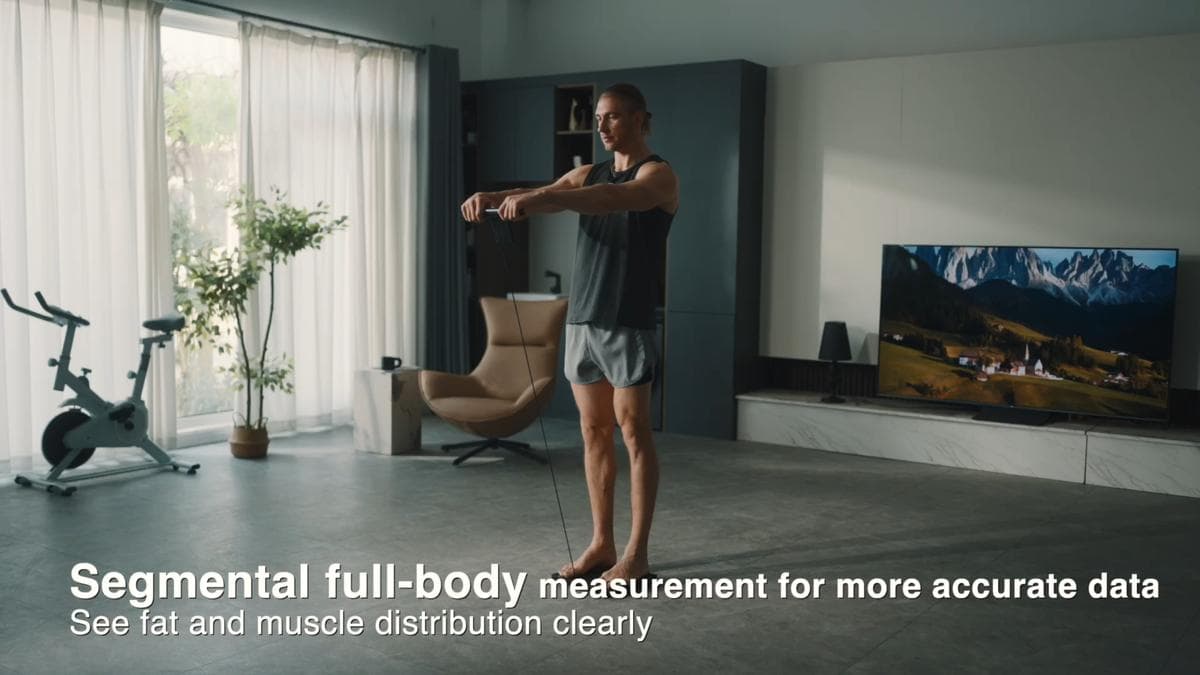
Most product video portfolios show the finished result. This post shows the actual production — a real project for a GE body fat scale, from the brief we received to the final delivery. The numbers are real. The process is real. The only thing we cleaned up was the studio floor between takes.
The brief
GE's product team needed a product video for their Smart Scale body fat monitor — a premium 8-electrode body composition scale with Bluetooth sync and full body composition analysis. The listing already had strong photography. What it needed was a video that showed the product in use: the step-on experience, the handle display reading, the app sync in action. 30 seconds, clean and premium. Timeline: 5 business days. Budget: $2,500.
You can also view the finished video on Amazon: https://www.amazon.com/dp/B0G1YVWXL5/
The studio constraint
Our Qingdao studio is large, but we didn't have a full living room set built for this specific product context. For a body composition scale — the kind with a large base and handle attachment — showing it in a real living room setting required a wider shot than our current set could provide. We had two options: build out a new set, or use the space we had and extend it digitally.
We chose the second option — not because AI generation is faster or cheaper, but because for this specific shot, it was the most honest way to show the product in the intended environment without compromising on what we actually filmed.
What we actually filmed
One day in the studio. Sony A7IV for product detail, a second camera for wider context. We filmed the scale at ground level to show the base profile and electrode surface, the step-on moment with feet making contact, the handle display reading out composition data, and the Bluetooth sync animation on a phone screen held beside the product. Clean white background, controlled lighting, real product.
The wide shot — the one that needed the expanded scene — showed the scale in a partial living room environment. We had the product, the light, and about 40% of the background we needed. AI scene extension filled the rest: the same floor material extended, the same wall tone carried through, the same light source providing context. What the viewer sees is a real studio product shot, not an AI-generated scene with a product dropped in.
When AI scene extension works — and when it doesn't
AI scene extension is not a replacement for a good studio setup. It's a tool for solving a specific spatial constraint: you have the right product, the right lighting, and the right angle — but not enough room to show the intended environment. In this case, the viewer needed to understand this scale belongs in a home setting, not a lab. The AI extension made that legible without forcing us to find and rent a full living room set.
It doesn't work when you have the wrong product shot to begin with. A product shot with inaccurate color, wrong proportions, or poor lighting will produce an AI extension that amplifies those problems rather than solving them. The AI layer requires accurate source material — it extends what's there, it doesn't fix what's wrong.
Delivery and client response
Final delivery: one 30-second Amazon listing video (16:9, 4K H.264 MP4), formatted for Amazon's player. Total production time: 5 business days from brief confirmation. Price: $2,500.
The client was satisfied with the production quality — so satisfied that they referred us to at least three other product teams within their organization. That's the metric we find most meaningful: not a conversion rate claim, but a client who trusted the output enough to recommend us to colleagues.
When hybrid production makes sense
- Product video for Amazon listings — when you need a real product shot with a contextual environment you can't physically access
- High-volume catalog work — multiple SKUs, same studio setup, AI extends the scene library without additional shoots
- Scale-phase creative — when you're testing multiple lifestyle contexts before committing to a full production
- Products where the real environment is impractical to film in (outdoor gear in actual outdoor conditions, large furniture in actual living rooms)
When full production is the better call: cinematic brand films with complex talent and location work, products where physical scale and texture are the entire selling proposition, or anytime you need a specific real-world location that AI can't convincingly replicate. AI scene extension is not a substitute for a great studio shoot — it's a complement for the constraints that make a great studio shoot impractical.
About the author
FlarePix Studio
Photo, video, and AI production
FlarePix is a product visual studio working with ecommerce and Amazon brands. Our team handles studio shoots, product video, AI lifestyle imagery, and AI video from one workflow, with delivery for Amazon, Shopify, and direct-to-consumer channels.
Related services
Need visuals for your products?
We help ecommerce and Amazon brands ship photo, video, and AI imagery fast.